
News
VENO tv: FOREIGN NEWS EBOLA SPREADS TO NEW PROVINCE IN DR CONGO AS HEALTH WORKERS STRIKE OVER UNPAID WAGES Contact tracing becomes increasingly difficult among displaced populations
Date: 15-08-26
By Kayode Adoide
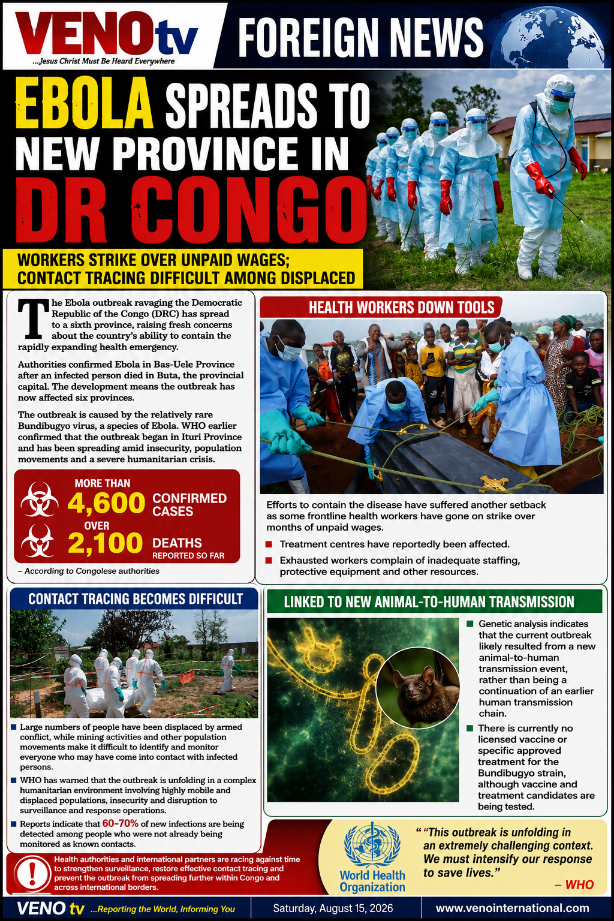
The Ebola outbreak ravaging the Democratic Republic of the Congo (DRC) has spread to a sixth province, raising fresh concerns about the country's ability to contain the rapidly expanding health emergency.
Authorities confirmed Ebola in Bas-Uele Province after an infected person died in Buta, the provincial capital. The development means the outbreak has now affected six provinces.
The outbreak is caused by the relatively rare Bundibugyo virus, a species of Ebola. WHO earlier confirmed that the outbreak began in Ituri Province and has been spreading amid insecurity, population movements and a severe humanitarian crisis.
HEALTH WORKERS DOWN TOOLS
Efforts to contain the disease have suffered another setback as some frontline health workers have gone on strike over months of unpaid wages. Treatment centres have reportedly been affected, while exhausted workers complain of inadequate staffing, protective equipment and other resources.
The outbreak has already recorded more than 4,600 confirmed cases and over 2,100 deaths, according to the latest figures reported by Congolese authorities.
CONTACT TRACING BECOMES DIFFICULT
One of the greatest challenges facing health authorities is contact tracing. Large numbers of people have been displaced by armed conflict, while mining activities and other population movements make it difficult for health teams to identify and monitor everyone who may have come into contact with infected persons.
WHO has previously warned that the outbreak is unfolding in a complex humanitarian environment involving highly mobile and displaced populations, insecurity and disruption to surveillance and response operations.
Reports indicate that 60–70 per cent of new infections are being detected among people who were not already being monitored as known contacts, highlighting serious gaps in surveillance.
OUTBREAK LINKED TO NEW ANIMAL-TO-HUMAN TRANSMISSION
Genetic analysis indicates that the current outbreak likely resulted from a new animal-to-human transmission event, rather than being a continuation of an earlier human transmission chain.
The situation remains particularly worrying because there is currently no licensed vaccine or specific approved treatment for the Bundibugyo strain, although vaccine and treatment candidates are being tested.
Health authorities and international partners are racing against time to strengthen surveillance, restore effective contact tracing and prevent the outbreak from spreading further within Congo and across international borders.
Date: 15-08-26
By Kayode Adoide
The Ebola outbreak ravaging the Democratic Republic of the Congo (DRC) has spread to a sixth province, raising fresh concerns about the country's ability to contain the rapidly expanding health emergency.
Authorities confirmed Ebola in Bas-Uele Province after an infected person died in Buta, the provincial capital. The development means the outbreak has now affected six provinces.
The outbreak is caused by the relatively rare Bundibugyo virus, a species of Ebola. WHO earlier confirmed that the outbreak began in Ituri Province and has been spreading amid insecurity, population movements and a severe humanitarian crisis.
HEALTH WORKERS DOWN TOOLS
Efforts to contain the disease have suffered another setback as some frontline health workers have gone on strike over months of unpaid wages. Treatment centres have reportedly been affected, while exhausted workers complain of inadequate staffing, protective equipment and other resources.
The outbreak has already recorded more than 4,600 confirmed cases and over 2,100 deaths, according to the latest figures reported by Congolese authorities.
CONTACT TRACING BECOMES DIFFICULT
One of the greatest challenges facing health authorities is contact tracing. Large numbers of people have been displaced by armed conflict, while mining activities and other population movements make it difficult for health teams to identify and monitor everyone who may have come into contact with infected persons.
WHO has previously warned that the outbreak is unfolding in a complex humanitarian environment involving highly mobile and displaced populations, insecurity and disruption to surveillance and response operations.
Reports indicate that 60–70 per cent of new infections are being detected among people who were not already being monitored as known contacts, highlighting serious gaps in surveillance.
OUTBREAK LINKED TO NEW ANIMAL-TO-HUMAN TRANSMISSION
Genetic analysis indicates that the current outbreak likely resulted from a new animal-to-human transmission event, rather than being a continuation of an earlier human transmission chain.
The situation remains particularly worrying because there is currently no licensed vaccine or specific approved treatment for the Bundibugyo strain, although vaccine and treatment candidates are being tested.
Health authorities and international partners are racing against time to strengthen surveillance, restore effective contact tracing and prevent the outbreak from spreading further within Congo and across international borders.
LINKS
- VENO tv: FOREIGN NEWS TRUMP: AMERICA WILL NEVER FORGET VICTIMS OF 9/11 ATTACKS, 25 YEARS AFTER- VENOtv POLITICS HEROIC WELCOME AS UDOEDEHE ARRIVES UYO AHEAD OF ADC 2027 CAMPAIGNS
- VENO tv: BUSINESS INVEST IN NIGERIA’S FUTURE: SUBSCRIBE TO DANGOTE REFINERY IPO THROUGH FIRSTBANK
- VENO tv: FROM THE PULPIT “DON’T LET YOUR ACHIEVEMENTS LIFT YOUR SHOULDERS IN PRIDE” — OMO OBA JESU DECLARES
- VENO tv: ENTERTAINMENT FAST-RISING ACTRESS PEJU AJIBOYE OPENS UP ON HER JOURNEY, LATEST MOVIE OJA EMI
- VENO TV FEATURE WHY YOU SHOULDN’T MISS FIRSTBANK’S AGRIC AND EXPORT EXPO 2026
- VENO tv: HOSPITALITY AMBER HOSPITALITY LAUNCHES IN LAGOS “Amber Feels Like Family”
- VENO tv FOREIGN NEWS CARGO PLANE CRASHES AT MIAMI AIRPORT Five Killed As Investigation Continues
- VENO tv Business FirstBank Empowers SMEs with Practical Sales Strategies at Upcoming SMEConnect Webinar
- VENO tv | AROUND TOWN ADELEKE JETS OUT ON VACATION, ORDERS PROBE INTO KOKA OBASHIP DISPUTE
- FROM THE PULPIT SUNDAY TONIC TURN BACK TO GOD AS SOON AS POSSIBLE — Pastor Princess Venisa Ojo a.k.a Omo Oba Jesu
- VENO TV: AROUND TOWN OBI, KWANKWASO JOIN AMAECHI FAMILY FOR MOTHER’S FUNERAL EVENTS
- VENO TV FOREIGN NEWS:IRAN–US WAR ESCALATES: WEDDING STRIKE VICTIMS BURIED AS TEHRAN RETALIATES
- VENO TV FOREIGN NEWS U.S. MINT RELEASES NEW $1 COIN FEATURING PRESIDENT TRUMP
- VENO TV: CJPAN MOURNS MEDIA ICON, SOLKEM …Says His Passion for Journalism, Excellence and Recognition of Outstanding Nigerians Will Remain an Enduring Legacy
- VENO TV: FEATURE OGOGO’S DEATH: ILARO CHIEF IMAM — AN EXEMPLARY LEADER
- VENO TV: POLITICS 2027: “SUBSIDY IS GONE” VS “SUBSIDY WILL RETURN” Tinubu: “Subsidy is gone.” Atiku Abubakar: “I will restore subsidy.”
- VENO TV EDITORIAL AS PRESIDENT TINUBU BEGINS THREE-WEEK EUROPE VACATION Shettima Was Away in Angola — What a Country!
- VENO tv: ENTERTAINMENT REGINA DANIELS REPORTEDLY RETURNS TO NED NWOKO’S MATRIMONIAL HOME
- VENO TV: CRIMEWATCH ALLEGED VISA FRAUD: TMT TRAVELS CEO IN POLICE NET AS OVER 200 COMPLAINANTS STORM STATION Owerri businessman previously drew attention over lavish birthday party organised for his dog
Page 1 of 68 [Next] [Last Page]